
Less Than Full Time Loan Adjustments
The One Big Beautiful Bill Act (H.R.1), signed into law by President Trump on July 4, 2025 is significant because it changes some rules related to the federal aid (Title IV) programs for students, families, and institutions like ASU-Beebe.
These changes are scheduled to go into effect July 1, 2026, and/or with the 2026-27 Free Application for Federal Student Aid. This means the changes will first go into effect in the Summer 2026 term.
Full-Time Academic Year Definition: To be considered full-time for the academic year:
- Undergraduate students: Must take 24 credit hours over the course of the fall and spring terms.
Half-time Enrollment: Students must be enrolled at least in a half-time load of financial aid-eligible classes to receive a Federal Direct Loan in any given semester. The minimum number of credits per semester to be considered half-time is:
- Undergraduates: 6 credit hours
Loan Amount: A student can receive the full annual Federal Direct Loan amount if their financial aid eligibility allows them to do so.
Award Calculation:

Current Rule Example Calculation
Example Student Award Offer:
Full-time Cost of Attendance (COA): $18,204
Grants: $7,395
Scholarships: $3,000
Federal Work Study: $2000
Remaining Eligibility: $5,809
This student has $5,809 of eligibility remaining before reaching the full Cost of Attendance.
Congress set the maximum annual Federal Direct Loan limit based on a student’s grade level.
For this example, the student is a Dependent Freshman with a maximum annual limit of $5,500. Since the student has $5,809 in remaining eligibility, they can receive the full $5,500 in a Direct Loan. Factors such as the Student Aid Index (SAI) will determine how much of the loan is subsidized versus unsubsidized, but the overall amount is capped at $5,500 per year.
If the student dropped from a full-time (12+ credit hours) load of financial aid eligible classes in the fall to three-quarter time (9-11 credit hours), the student could keep the entire $5,500 if the adjusted COA would leave enough remaining eligibility to do so. In most cases, it would.
- Full-Time Academic Year Definition (No change from the current rules): To be considered full-time for the academic year:
- Half-time Enrollment (No change from the current rules): Students must be enrolled for at least a half-time load of financial aid-eligible classes to receive a Federal Direct Loan in any given semester. The minimum number of credits per semester to be considered half-time is:
- Less than Full-Time Enrollment: Starting with the 2026–27 award year, Direct Loan amounts for students who are not full-time for the full academic year will need to be adjusted. This is called a Schedule of Reduction, or SOR change. Full-time enrollment is determined by term and by the academic year, whereas, prior to this, the rules were limited to enrollment in a single term.
- Award Calculation:

From here, multiply the less-than-full-time percentage (see below for this calculation) by the full-time annual loan eligibility to determine the less-than-full-time loan amount.
- Less than full-time formula for loan eligibility:
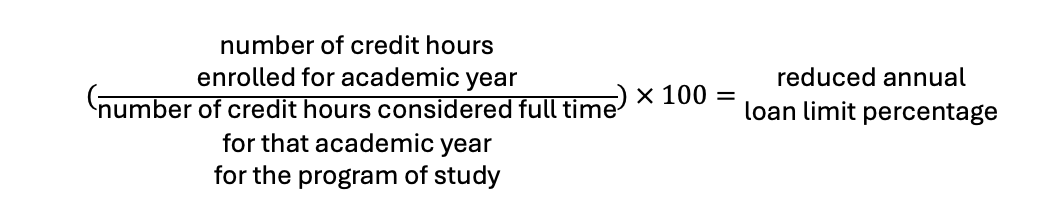
This adjustment rule applies to all undergraduate Direct Loan borrowers utilizing Direct Subsidized and Unsubsidized Loans. Even those considered legacy borrowers who have borrowed from any of these loan programs prior to July 1, 2026, are subject to this rule.
Since this rule only impacts student borrowing, the Federal Direct Parent PLUS Loan is not subject to these adjustments for less-than-full-time study.
Example Student Award Offer:
Let’s say you’re a Dependent Sophomore who can borrow up to $6,500 (typically $4,500 in subsidized and $2,000 unsubsidized) in student loans for the school year. You plan to take 12 credit hours in the fall and 12 credit hours in the spring, which makes you a full‑time student (full‑time = at least 12 credits each term).
That means:
- Full-time for the year = 24 credits (12 fall + 12 spring)
- Your loan normally comes in two equal payments:
- Fall: $3,250 ($2,250 subsidized + $1,000 unsubsidized)
- Spring: $3,250 ($2,250 subsidized + $1,000 unsubsidized)
This means a student in this category cannot receive more than these loan amounts for the entire academic year, including summer, fall, and spring (in that order). In the past, students could take as few as six credits per term and still receive the full loan amount. Now, loan eligibility is adjusted based on a student’s scheduled enrollment (SOR).
What Happens When You Drop a Class
If you drop from 12 credits to 9 credits in the fall before your loan is disbursed, your loans must be reduced because you are now on track to complete 21 hours instead of 24 hours.
Your New Plan for the Year
- Fall: 9 credits
- Spring (expected): 12 credits
- Total: 21 credits
Originally, full‑time for the year was 24 credits, but now you’ll only have 21 credits.
Percent of Full-Time You’re Completing
(21 ÷ 24) x 100 = 87.5% (rounded to 88%)
This means you are scheduled to complete 88% of the credits needed to be considered full‑time for the combined fall and spring terms.
How This Affects Your Loan
Since you’re only completing 88% of the needed credits, you can only receive 88% of your $6,500 loan limit:
- $4,500 x 88% = $3,960 subsidized
- $2,000 x 88% = $1,760 unsubsidized
These figures represent the student’s new annual loan limits. ASUB will adjust the loans by evenly splitting the reduced amounts between fall and spring, like full‑time awarding. As a result, the student will receive:
- $1,980 in subsidized loans in fall and spring
- $880 in unsubsidized loans in fall and spring
Example Student Award Offer:
Let’s say you’re a Dependent Sophomore who can borrow up to $6,500 (typically $4,500 in subsidized and $2,000 unsubsidized) in student loans for the school year. You plan to take 12 credit hours in the fall and 12 credit hours in the spring, which makes you a full‑time student (full‑time = at least 12 credits each term).
That means:
- Full-time for the year = 24 credits (12 fall + 12 spring)
- Your loan normally comes in two equal payments:
- Fall: $3,250 ($2,250 subsidized + $1,000 unsubsidized)
- Spring: $3,250 ($2,250 subsidized + $1,000 unsubsidized)
What Happens When You Drop a Class
If you drop from 12 credits to 9 credits in the fall AFTER your loan has been disbursed, your total loans for the year will need to be reduced. This may create a bill to repay loan money already disbursed in the fall, or a reduction to loans you anticipate receiving in the spring.
Before giving you the spring portion of the loan, ASUB must verify how many credits you are going to finish for the combined fall and spring terms.
Your New Plan for the Year
- Fall: 9 credits
- Spring (expected): 12 credits
- Total: 21 credits
Originally, full‑time for the year was 24 credits, but now you’ll only have 21 credits.
Percent of Full-Time You’re Completing
(21 ÷ 24) x 100 = 87.5% (round to 88%)
This means you are scheduled to complete 88% of the credits needed to be considered full‑time for the combined fall and spring terms.
How This Affects Your Loan
Since you’re only completing 87.5% of the needed credits, you can only receive 88% of your $6,500 loan limit:
Your new eligibility for the year is $6,500 x 88% = $5,720
How You Could Still Get the Full Spring Loan
If you take 15 credits in the spring, then your total for the year becomes:
- Fall: 9
- Spring: 15
- Total: 24 credits
Now you’re back to completing a full‑time year. If your loans were reduced for the spring term based on the fall enrollment change, this means they can be increased so the total of your academic year loan equals the $6,500 limit (assuming you meet the rest of the general eligibility criteria to receive that amount).
The Department of Education has not published final guidance for implementing the One Big Beautiful Bill Act. As a result, answers to the FAQ’s are based on our current understanding of the law and are subject to change.
How many credit hours do I need to be enrolled in to be considered a full-time student for Direct Loan eligibility?
A minimum of 12 financial aid-eligible credit hours per term is considered full-time in a term; however, 24 hours over the course of the fall and spring terms are needed to be considered full-time over the course of the academic year.
What happens to my Federal Direct Loan eligibility if I change my schedule to less than full-time before my loan is disbursed?
If you are enrolled for 12 financial aid-eligible credit hours in the fall term and reduce your schedule to less than full-time before your fall loan is disbursed, ASUB will have to reduce your fall loan based on the new rules.
What happens to my Federal Direct Loan eligibility if I change my schedule to less than full-time after my loan is disbursed?
Loan reductions for less than full-time enrollment are calculated based on the academic year minimum, not the term. Students who complete 24 financial aid-eligible credit hours between the fall and spring terms are considered full-time for the academic year. Those who do not are subject to having their loans reduced.
Will my Parent PLUS Loan be reduced if I am enrolled for less than full-time?
Parent PLUS Loans are not reduced the same way as Direct Subsidized Loans and Direct Unsubsidized Loans for less than full-time enrollment.
The One Big Beautiful Bill Act introduces significant changes to federal student aid programs, and while some provisions are clear, many others require further clarification from the U.S. Department of Education.
We understand that students, families, and staff have questions—and so do we.
As we receive more guidance and official updates, we will continue to revise and expand this webpage to reflect the most accurate and actionable information available.